The Majority Rule Pledge
May 12th, 2013"No minority has a right to block a majority from conducting the legal business of the organization. No majority has a right to prevent a minority from peacefully attempting to become a majority." Robert M. Pirsig, American philosopher and author of "Zen and the Art of Motorcycle Maintenance," put that terse summary of Robert's Rules of Order in his later book, "Lila." To Pirsig, those two sentences set a framework for a democracy where "Dynamic Quality" can flourish, and society can evolve. But unluckily, in the world's first modern democracy one party has battered and cracked that framework. In both houses of the U.S. Congress a reckless minority of Republicans routinely blocks a majority from conducting the business of the nation.
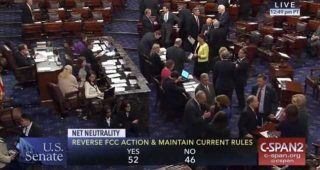
In the Senate the Republican minority blocks the nation's business with the silent filibuster rule. Originally, the filibuster was a seldom-used tactic for a Senator to demonstrate one's displeasure with an issue by holding the floor for as long as one's wind held out. But the silent filibuster has practically become a 60% vote requirement. Since 2007, the minority Republicans have filibustered way more than any group before. They have filibustered legislation, such as that to close loopholes to keep the crazy and criminal from buying guns. And they have filibustered confirmations, such as that for director of the Consumer Financial Protection Bureau, trying to block its work, and for judgeships, creating a "judicial emergency" in 33 districts and circuits.
In the House a minority formed of the Republican Teabag Caucus and its followers blocks action on any bill it opposes with the "majority of the majority" rule. Also known as the "Hastert Rule," after the Republican speaker of the House that made it official party policy, it states that no bill comes to the floor, unless the speaker knows that a majority of Republicans, now a 233-201 majority in the House, favors it. Under the majority of the majority rule, any bill favored by a majority formed of most Democrats and less-than-half of Republicans would not come to the floor. Take for example H.R. 199, which closes a corporate tax loophole on a deduction for executive compensation of more than a half million a year. Such a sensible budget bill just might get 17 Republicans to join 201 Democrats for a majority to pass it. Or take H.R. 163, which protects the Sleeping Bear Dunes area of the Lake Michigan shore as a national wilderness area. That bill is sponsored by twelve Michigan congressmen of both major parties, and would very likely pass before the whole House. But it might be tough to get a majority of House Republicans, who in the last Congress passed a bill that would have gutted the Wilderness Act.
Now, this battered and cracked Congress can be fixed by electing more sane and sensible persons to it. In the Senate, a simple majority can change the rules, and dump the silent filibuster. Voters could enable that in the primary election by ousting any senator that won't support majority rule. And in the House, the majority party leaders could simply reject the majority of the majority rule. Voters could enable that in the general election by voting in the Democrats, who have never adopted such a rule. To help voters, a candidate in favor of fixing Congress would do well to sign a pledge for democracy and majority rule:
Majority Rule Pledge

54 yeas to 46 nays - CNN calls that 'voted down.' I call it FILIBUSTERED!
Sources
Read the rest of this entry »
Print this article.
Book Review: “America’s Stolen Narrative” by Robert Parry
March 21st, 2013- Nixon's Vietnam Peace Sabotage: "Huh, no. My God, I would never do anything to encourage ... Saigon not to come to the table," said Nixon to President Lyndon Johnson. Late in the 1968 presidential election season, Johnson was close to getting both North and South Vietnam to meet for peace talks in Paris. Such progress towards peace could have given a boost to Vice President Hubert Humphrey over Nixon in the presidential race. But someone from the Nixon camp felt sure it had the peace talks blocked, and sent that inside dope to some Wall Street banker buddies. Johnson caught wind of that, and ordered wiretaps. Soon, he got proof that the Nixon camp was urging South Vietnam to stay away from the peace talks, and offering a "better deal" should Nixon become president. When Johnson sent word that he might go public with the proof, "Tricky Dicky" Nixon phoned to try to fool Johnson with the lie quoted above. The Christian Science Monitor had also caught wind of Nixon's sabotage, and, before running the story, sought confirmation from the administration. But Johnson decided, "for the good of the country," not to go public. And, as it happened, the government of South Vietnam did stay away from the peace talks, Nixon won a close election, and the killing went on for four more years. And so began a recurring pattern where high Republican officials would do dirty deeds, some treasonous, some criminal, and high Democratic officials would cover them up.
- The Road to Watergate: "Godammit, get in and get those files. Blow the safe and get it," said Nixon to his staff members, H.R. Haldeman and Henry Kissinger. In June 1971, Nixon gave that command to break-in to the Brookings Institution, most likely to get the file with Johnson's proof of Nixon's treasonous peace talk sabotage – a file that could scuttle his re-election. And so we see, a year before their Watergate break-ins, the beginnings of Nixon's band of criminals known as the "Plumbers." But, before he left office, Johnson gave the file to his adviser Walt Rostow, and so kept it away from Nixon. In 1973, after Johnson's death, and as Nixon's presidency began to crumble from the Watergate scandal, Rostow sent the file, which he labeled "the X envelope," to the LBJ Library. He thought the contents to be such a blot on the U.S.A., that he wrote an instruction to keep it sealed for 50 years, at which time the library's director could open it, and decide to seal it for another 50 years. But in 1994, "just" 21 years later, Rostow and the library's director decided to open the file, and today it is largely declassified.
- October Surprise: The movie "Raiders of the Lost Ark" portrayed a vast underground government archive warehouse, where the powerful Ark of the Covenant was to be stashed for all time. That is how Lawrence Barcella, chief counsel of the House's October Surprise Task Force, imagined the place where he had sent the Russian Report on the plot. The report came from old Soviet intelligence files, and was sent by the Russian parliament, to answer a request from the task force. But Robert Parry got a pass to the archive warehouse and copied the Russian Report, and other documents, from the boxes of task force materials he found there. The documents backed reports of some 24 witnesses to the deal between presidential candidate Ronald Reagan's camp and Iranian leader Ayatollah Ruhollah Khomeini's faction. The deal went through: the Iranians, who had been holding 52 Americans hostage for nearly a year, delayed their release until Reagan took office, and the Reagan people sent arms to Iran. The Russian Report confirmed that Ronald Reagan's campaign chief William Casey, Reagan's running mate George H.W. Bush, and CIA officer Robert Gates were among those who met with Iranians in 1980. Like the treasonous Nixon, Reagan became president helped by his camp's sabotage of negotiations by the sitting president, Jimmy Carter in this case. Unlike Nixon's Vietnam peace talk sabotage, the October Surprise plot got a Congressional investigation, spurred in part by Robert Parry's reporting for PBS's "Frontline." And though Barcella asked for a three-month extension to study other new evidence flowing in, the committee, led by Lee Hamilton (D – IN), rushed to wrap up the investigation, skipping the Russian Report, making up alibis, and clearing the Republicans due to "no credible evidence."
The book also tells the stories of:
- how the government of Israel helped the Reagan crew set up the October Surprise plot and the arms pipeline through Israel to Iran, which likely continued into the Iran-Contra scandal.
- how the Bush I White House foiled the October Surprise and Iran-Contra investigations with a program of media pressure, arm-twisting, subpoena-dodging, and delay, while raising a stink about the cost of the probes.
- how alibis for high-level Republicans, such as George H. W. Bush and William Casey in October Surprise, and Robert Gates in Iraqgate, dissolved after a little investigation.
- how two ladder-climbers, Colin Powell and Robert Gates, by doing dirty deeds and cover-ups for their bosses, rose to the highest levels of government, while being toasted by the Washington Establishment.
- how the American Right tries to revise history with its ideas of constitutionality that are more in line with the Articles of Confederation than with the Constitution, whose authors aimed for a strong, pragmatic central government under sovereignty of "We the People."
A nice feature of the book is that many of its notes have web links to original documents and recordings. For example, here is a link that shows the sign-in sheet that helped dismantle Robert Gates' alibi that he was at a White House meeting with the prime minister of Belize and not at an Iraqgate meeting with an Israeli intelligence agent on April 20, 1989. And here is a link where you can hear the phone call noted above, where Nixon lies to Johnson about sabotaging the Vietnam peace talks.
The book's author, Robert Parry, wrote some of the earliest stories of Iran-Contra and October Surprise. He has followed up on these and other such stories, digging up and keeping up on new evidence along the way. "America's Stolen Narrative" is the latest, and, I think, the greatest, result of that work. It is not a long book -- 221 pages not counting the index and notes – but it is a meaty book. Virtually every word in it advances the stories told. And they are the classic product of investigative reporting – exposés of dirty, anti-democratic deeds by the highest officers of the republic, a type of story crucial to an informed citizenry in a democracy. These stories show that some conspiracies really are true. But, as the author points out, it is only "careful research and open-minded reporting" that can separate what is real from what is "just a curious anomaly or something hard to explain." While these stories were largely missed in real time, they are here now, and should rightfully become well-known American history. You the reader can help that come to pass.
To buy "America's Stolen Narrative":
- Paperback from Robert Parry's site, Consortiumnews.com
- Paperback from Amazon.com
- e-Book for Nook from Barnes & Noble
- e-Book for Kindle from Amazon.com
I have several copies of Robert Parry's prior book, "Neck Deep - The Disastrous Presidency of George W. Bush" to give away. E-mail me your (U.S.) mailing address, and I will, while they last, send one to you postpaid.
Sources
Read the rest of this entry »
Print this article.
Gun Control Poll: Which arms would you ban?
January 31st, 2013Moore: Mm, put the hammer back.
Nichols: No one has the right to tell me I can't have it. That is protected on our constitution.
Moore: Where does it say a handgun is protected?
Nichols: No, gun. We should...
Moore: [interupting] It doesn't say gun. It says "arms".
Nichols: Arms. What is "arms"?
Moore: Could be a nuclear weapon.
Nichols: It's not these - That's right. It could be a nuclear weapon!
Moore: Do you think you should have the right to have weapons-grade plutonium here in the farm field?
Nichols: We should be able to have anything...
Moore: [interupting] Should you have weapons? Should you have weapons-grade plutonium?
Nichols: I don't want it.
Moore: But, should you have the right to have it if you did want it?
Nichols: [thinking about it] That should be restricted.
Moore: Ah! Ah, so you do beleive in some restrictions?
Nichols: Well, there's wackos out there.
Where would you set the limit of what arms you – and your next-door neighbor – could legally keep at home? In the poll below, pick one level of banning. Each ban includes all those prior.
Sources
Read the rest of this entry »
Print this article.
Fat Cats Push Big Benefit Cuts, Prompt Time-Tested Tax Hikes
December 26th, 2012Since the onset of the greed-is-good era, and even more so with the clamor over the "fiscal cliff," some fat cats have been pushing hard to cut benefits to the old, the disabled and the poor from the big public insurance programs -- Social Security, Medicare and Medicaid.
For instance, Peter Peterson ($1.2B net worth), who made his fortune with a boost from the fund manager's tax break, has so far spent $485M on hyping the national debt problem and pushing propaganda to undermine the public insurance programs -- what he has called "the entitlement monster." He said, "We have to protect the very poor, but it's a period of shared sacrifice." But, in the throes of the Great Recession, the non-rich have already sacrificed. And if we would bring back the top bracket ($2.3M in 2011 $'s) 91% income tax rate that was in place from 1941 to 1964, we might help Peterson with his end of the "shared sacrifice."
Another such fat cat, Lloyd Blankfein ($450M), runs Goldman Sachs, a company that throughout history has inflated Wall Street bubbles, including the housing bubble that popped to bring the bank crashes of 2008 and the Great Recession. Blankfein is a member of the CEO council of the Peterson-funded "Fix the Debt" organization, which was established during the "fiscal cliff" clamor. About the public insurance programs, Blankfein said, "You're going to have to undoubtedly do something to lower people's expectations -- the entitlements and what people think that they're going to get, because ... they're not going to get it." But wouldn't it be better to instead lower Goldman Sachs's expectations? If we would bring back the .04% stock transfer tax, which was in place from 1932 to 1966, we might lower them a bit, and might even slow Goldman Sachs's work on the the next bubble and crash.
Other such fat cats, the brothers Charles and David Koch ($31B each), own and run Koch Industries, which they inherited from their father. The Kochs bankroll so wide an array of political groups -- such as the Heritage Foundation, ALEC and the Teabag Party -- that it is called the "Kochtopus." The Kochtopus also pushes propaganda to undermine the public insurance programs, as well as to stifle action on global warming. And the Koch brothers seem to approach their policy drives with the same results-oriented, focused follow-through that has worked in their company business. Charles Koch said, “To bring about social change [requires] a strategy [that is] vertically and horizontally integrated, [spanning] from idea creation to policy development to education to grassroots organizations to lobbying to litigation to political action.” Though it would hardly be enough to corral the Kochtopus, if we would bring back the top bracket ($40M in 2012 $'s) 77% estate tax rate, which was in place from 1941-1976, we might at least, when the Kochs' children take the reins, slow the flow of its poison.
So, before we cut one dollar going to the old, the disabled and the poor, let's try bringing back tax rates that worked during the prosperous times before the greed-is-good era, and that would raise many billions for the public till.
Sources and Notes
Read the rest of this entry »
Print this article.
Questing Traveler Finds World-Full of Friendly People
December 2nd, 2012
The main feeling today is just one of intense gratitude to every person around the world who helped me get here, by giving me a lift, letting me stay on their couch, or pointing me in the right direction.
Thus spoke Graham Hughes Monday from Juba, South Sudan -- the 201st and last country of his surface journey to every country in the world. A hiker and filmmaker from Liverpool, Hughes made the quest alone, on one continuous route, without flying and without driving. Along the way, he shot video, blogged, and hosted the "Graham's World" show on the National Geographic Adventure Channel. With the publicity, he raised money for a charity that brings sanitation and safe drinking water to the world's people that lack it.
Hughes began his journey on New Year's Day, 2009, after reveling in Buenos Aires the prior night. He got up late, rushed to catch the ferry, and crossed the first border of his journey -- the River Plate into Uruguay.
They say that every journey begins with a first step. Mine began with a drunken stumble.
Staying on a shoestring budget of, on average, less than $100 a week, Hughes traveled with and stayed with local people, and ate only local food.
I think if I didn't harbor certain personality traits, I couldn't actually do this. I'm stubborn and fairly arrogant, but I'm also friendly and jovial with pretty much everyone I meet, which goes a long way.
Though being outgoing and friendly, Hughes did not join every crowd he came upon.
I arrived in Bucharest around lunchtime and headed to the coach station. A political rally was taking place in the park between – I gave it a wide berth. I’ve never been one for mob mentality; I prefer to operate under the radar, subverting people’s opinions by means of stealth, cunning and outright ridicule.
And while skilled at blagging, Hughes could not sway every person he met.
The first time I was thrown in jail was after a boat ride to Cape Verde ... I'd arrived on a fishing boat with a bunch of Senegalese fishermen, and naturally the policemen at the port assumed I was a people smuggler. No talking them out of it. I ended up sleeping on the floor of a tiny jail cell with 10 other people for five nights before I was freed without charge.
Hughes knew from the start that he was taking a leap of faith in strangers.
There is no precedent for this. I can’t refer to a single book or call up one person and ask them how to do it – I’m making it up as I go along, dealing with the best information I can lay my heads on and leaving myself completely at the mercy and good will of my fellow human beings from Timbuktu to Kathmandu.
And strangers came through for him. Hughes posted a picture of and a note about many of them -- for example:
The other reason that Iran is now in my Top Ten countries of the world is this guy here. I was on the overnight coach from Shiraz to Khorramshahr when the dear old lady in front of me who didn’t speak a word of English passed me her mobile phone. The guy on the other end of the line explained that the lady was his grandmother and that she was concerned that the bus got in at 5am and I’d have nobody to meet me. He invited me for breakfast at Granny’s house (how could I refuse?) and sure enough, Hossein picked me up the next morning and we shared the most scrummy breakfast in the world in Granny’s flat. After breakfast he drove me down to the port and made sure I made it safely onto the ferry to Kuwait.
But there were many more helpful strangers than Hughes could list.
The following people are just some of the many ODYSSEY HEROES – believe me, there are many more, but it’s not always possible to snap a pic of border guards who welcome me into their country with a cup of tea, the policeman who slips his mobile phone through the cell bars so I can call for help or the bus driver who drives through the night to get me where I need to be.
As you might imagine, Hughes' journey brought many highlights.
But, for Graham Hughes, one broad highlight stood out.I ... spent seven days in Tibet and warned schoolchildren in Afghanistan about the dangers of men with beards.
I met the Prime Minister of Tuvalu, rode on top of a 18-wheeler through the northern badlands of Kenya, hitched a ride on a cruise ship to The Dominican Republic, joined a Bwiti tribe in Gabon, screamed at the ocean in El Salvador and watched a space shuttle blast off in the USA.
I've fed the crocs in Australia, hunted the dragons of Komodo, befriended the orangutans in Borneo, played with the lemurs in Madagascar, washed the elephants in India and eaten live octopus in South Korea.
I ... danced with the Highlanders of Papua New Guinea and was rescued from Muslim fundamentalists in The Philippines by a ladyboy called Jenn.
The main highlight I have to say, ... for me, has been the reaffirmation of my faith in humanity and the fact that people I have met on the road have been so friendly and hospitable.

Graham Hughes' route as GPS bread crumb trail.
CLICK for Country Checklist.
Sources
Read the rest of this entry »
Print this article.


Powered by