Two Types of Romnesia

October 28th, 2012

Romnesia is a memory malady typified by the 2012 United States presidential candidate, Mitt Romney. There are at least two types of this malady. The first type is the habitual politician's flip-flop, but, upon taking the "flop" position, blacking-out on having ever held the "flip". Among the many that have noted this malady in Romney is Rudy Giuliani, a candidate for the 2008 Republican presidential nomination. He said, "I've never seen a guy change his positions on so many things so fast, on a dime." After the second candidates' debate, Romney's opponent, President Barack Obama, sought to define this type of Romnesia:

[N]ow that we’re 18 days out from the election, Mr. “Severely Conservative” wants you to think he was “severely kidding” about everything he’s said over the last year. He told folks he was “the ideal candidate” for the Tea Party, now suddenly he’s saying, “what, who, me?” He’s forgetting what his own positions are, and he’s betting that you will too.

I mean he’s changing up so much – backtracking and sidestepping. We’ve gotta name this condition that he’s going through.. I think it’s called “Romnesia.” That’s what it’s called. I think that’s what he’s going through.

Now, I’m not a medical doctor but I do want to go over some of the symptoms with you because I want to make sure nobody else catches it.

If you say you’re for equal pay for equal work, but you keep refusing to say whether or not you’d sign a bill that protects equal pay for equal work – you might have Romnesia.

If you say women should have access to contraceptive care, but you support legislation that would let your employer deny you contraceptive care – you might have a case of Romnesia.

If you say you’ll protect a woman’s right to choose, but you stand up at a primary debate and said that you’d be “delighted” to sign a law outlawing that right to choose in all cases – man, you’ve definitely got Romnesia.

Now, this extends to other issues. If you say earlier in the year I’m going to give a tax cut to the top 1 percent and then in a debate you say, I don’t know anything about giving tax cuts to rich folks – you need to get a thermometer, take your temperature, because you’ve probably got Romnesia.

In later stump speeches, Obama warned against contagion:

[Governor Romney]’s hoping that you come down with what we call a case of ... Romnesia. He’s hoping you won’t remember that his economic plan is more likely to create jobs in China than here in Ohio, because it rewards companies that ship jobs overseas instead of companies that are creating jobs right here in Ohio, right here in the United States of America.

He’s hoping you won’t remember that he wants to give millionaires and billionaires a $250,000 tax cut. And the reason he can’t explain it is because the only way to pay for it is either by blowing a hole in the deficit, making it even bigger, or making your taxes higher.

... He’s hoping that if he just keeps on saying how much he loves cars over and over again that you won’t remember he wrote an article that was titled, “Let Detroit Go Bankrupt.”

The second type of Romnesia is the illusion of the rich person born on third base that thinks one hit a triple, but blacking-out on one's given advantages to the point of losing sympathy and a sense of responsibility towards those without such advantages. The columnist, George Monbiot, defined this type of Romnesia in an article published in September:

We could call it Romnesia: the ability of the very rich to forget the context in which they made their money. To forget their education, inheritance, family networks, contacts and introductions. To forget the workers whose labour enriched them. To forget the infrastructure and security, the educated workforce, the contracts, subsidies and bail-outs the government provided.

...

There is an obvious flip-side to this story. “Anyone can make it – I did without help” translates as “I refuse to pay taxes to help other people, as they can help themselves”.

Monbiot points out one symptom that the son of privilege Romney showed, blacking-out on a multi-million dollar federal bailout that saved his career:

... “Everything that Ann and I have,” Mitt Romney claims, “we earned the old-fashioned way”. Old-fashioned like Blackbeard perhaps. Two searing exposures in Rolling Stone magazine document the leveraged buyouts which destroyed viable companies, value and jobs, and the costly federal bail-out which saved Romney’s political skin.

Rolling Stone told how Bain and Company, after being bled dry by its founders, and tainted in a stock manipulation scheme, called Romney to the rescue. After Romney's first rescue try failed, he pulled strings and issued threats to get a $10 million bailout from the FDIC. That federal bailout saved the management consulting company, as well as Romney's future massive wealth and his political resumé. But of the federal bailout that saved the U.S. auto industry, Romney said, "[I]t was the wrong way to go."

Sources

Read the rest of this entry »
Share
Print this article. Print this article.

How to Vote in Ohio 2012

September 26th, 2012


(Voter info below.) Before 2004, there was one way to vote in Ohio. You signed in on voting day, punched your ballot, saw it dropped into the ballot box, and walked away knowing you'd done your duty. Since then, a series of Republican moves to hamper voters countered by Democratic moves to help voters, has brought changes. In 2004, Secretary of State, and Bush-Cheney Ohio campaign chairman, Ken Blackwell oversaw a presidential election with such hindrances as too few voting machines, Republican vote challengers, denial and rejection of provisional ballots, and many hours-long lines, mostly in big cities and college towns. The next year citizens petitioned for ballot issues to prevent recurrence of such troubles. One of the issues would have let any voter get an absentee ballot without giving a reason. Though the issue later failed, it seemed to prompt the Republican General Assembly to head it off by passing it, but with an ID requirement. In 2006, Republicans passed more voting restrictions to require ID, hamper voter registration drives, eliminate the random audit of voting machines, and hamper or ban contests of election results. And last year Ohio Republicans passed a law to pare back early voting, allow poll workers to neglect helping a voter to the right precinct table and ban elections boards from mailing out absentee ballot requests. But citizens petitioned to repeal that law. And facing a strong chance that the repeal would pass, state house Republicans, making history, repealed their own law just to keep voters from doing it. Still, the Republicans kept a little something of their anti-voting law: the ban of early voting the week-end before Election Day. Having also been passed in a separate law, that ban stayed on the books. But Democrats brought a court challenge, and a federal judge threw out the week-end voting ban. (Update: Republicans appealed that ruling to the U.S. Supreme Court and lost.) In another move to hamper voters, Republican Secretary of State Jon Husted issued tie-breaking votes against longer early voting hours in Democratic-leaning counties, while some Republican-leaning counties had already voted for the longer hours. But after an outcry by Democrats and newspapers, Husted issued uniform hours for all 88 counties, though with less after-work and weekend hours than some counties had in 2008. Also, Husted issued a ban on county boards of elections mailing out absentee ballot requests. So the Cuyahoga County Council voted to do the job itself. With no authority to stop it, and facing the prospect of having just heavily-Democratic Cuyahoga County mailing absentee ballot requests, Husted had his own office mail them out to all registered voters in the state. After all these changes, there are more ways to vote in Ohio. But you can still walk away -- from polling place, elections office or mail box -- knowing you've done your duty.

Ohio Voter Information

  • Registration Deadline: Tuesday, October 9th
  • Register now!
    1. CLICK HERE to fill in an online registration form, and print it out.
    2. Sign and date the form.
    3. Put the form in an envelope and address it to your county elections board. CLICK HERE for the address.
    4. Stamp and mail the envelope so that it is postmarked by October 9th. Note: A postage meter mark won't work – use a stamp.
  • Register in person: You can also register in person at many places, including any public library, any BMV office, many city halls, and boards of education or high schools.
  • Confirmation: Within 20 days of registering, the county board of elections will mail you a postcard stating where your polling place is. Also, the secretary of state will mail you an absentee ballot request form.
  • Check your registration: If you received an an absentee ballot request form from the secretary of state, it should serve to verify that you are registered. Or you can CLICK HERE for a search form to check that you are registered. If the online search does not find your registration, call your county elections board to check -- CLICK HERE for the phone number.
  • How to vote: You can vote by absentee ballot, early in person or on election day.
  • Absentee Ballot: You can vote an absentee ballot by mail without giving a reason. Mail your ballot to the county elections board by Noon Saturday, November 3rd (to be postmarked by Monday, November 5th), or drop off your ballot at the elections board during open hours on any day up until the polls close on election day. If you did not get an absentee ballot, check your registration. To request an absentee ballot, CLICK HERE for the request form, fill it in and mail it to your elections board -- CLICK HERE for the address. NOTE: Once you request an absentee ballot, you must vote that absentee ballot, and can no longer vote a regular ballot, neither early nor on election day. (Though you could vote a provisional ballot, which gets counted last.)
  • Early In-Person Voting: You can vote early in person at your board of elections (or maybe another site -- call to check) from October 2nd through November 5th, as follows:
    • Oct 2 - 5 (Tue - Fri): 8 to 5
    • Oct 9 (Tue): 8 to 9
    • Oct 10 - 12 (Wed - Fri): 8 to 5
    • Oct 15 - 19 (Mon – Fri): 8 to 5
    • Oct 22 – 26 (Mon – Fri): 8 to 7
    • Oct 29 – Nov 1 (Mon to Thr): 8 to 7
    • Nov 2 (Fri): 8 to 6
    • Nov 3 (Sat): 8 to 2
    • Nov 4 (Sun): 1 to 5
    • Nov 5 (Mon): 8 to 2
  • Election Day: Vote at your polling place. Election day is Tuesday, November 6th, voting hours are from 6:30 a.m. to 7:30 p.m. Bring your driver’s license or a document showing your voter registration address, such as a utility bill.
  • Contribute: You can contribute to state candidates and get your money back as a credit on your Ohio income tax — up to $50 filing singly, or $100 filing jointly. The credit applies to all state-wide candidates, including those for the Ohio Supreme Court (but not the U.S. Senate), and to state legislative candidates.
  • Sources

    Read the rest of this entry »
    Share
    Print this article. Print this article.

    CFPB & PPACA Pay Off for Americans’ Wallets, Obama’s Resumé

    August 26th, 2012

    Two well-known acts of the Democratic-majority Congress of 2009-2010 have begun to pay off – literally – for Americans. One is the Dodd-Frank Wall Street Reform and Consumer Protection Act, which created the Consumer Financial Protection Bureau (CFPB). The CFPB sets and enforces standards for bank dealings with customers. Last month, the CFPB issued its first enforcement order*, following a probe of Capital One Financial Corporation. Capital One was misleading and pressuring customers to buy "payment protection" or "credit monitoring," when one would call in to activate one's credit card. Under the order, the bank will give each swindled customer a full refund, with interest, automatically* – no claim form needed. That adds up to about $140M for about 2 million customers. Also, Capital One will pay $25M in fines to the CFPB, and an additional $45M, including restitution for unfair billing practices, levied by the Office of the Comptroller of the Currency (OCC). The other well-known act of Congress that is putting money back in Americans' wallets is the Patient Protection and Affordable Care Act (PPACA), also known as "Obamacare", which has set standards for medical insurance. One of those standards is that a medical insurance company pay out 80% (85% for large employer plans) of the premiums it gets for actual health care, not administrative costs and profits. Over the past month or two, about 12.8 million customers have been getting $1.1B in rebates, automatically, from insurance companies that had a shortfall in actual health care spending last year. Neither of these acts would have passed without push from President Obama*, so these fair payments to Americans add two bullet points to the president's re-election resumé. By contrast, Mitt Romney, Obama's opponent in the presidential race, has said that he would repeal both the CFPB and the PPACA.

    Sources

    Read the rest of this entry »
    Share
    Print this article. Print this article.

    Ohio Fights Grotesque Gerrymanders

    August 6th, 2012

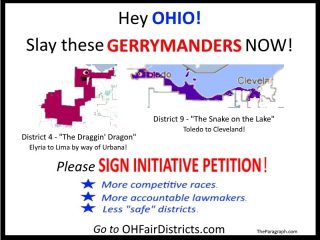
    "This plan is the most grotesque partisan gerrymander that I, as a political scientist, have ever seen," said Professor Richard Gunther of Ohio State University. Gunther was speaking of Ohio's new congressional district map, created by Republican state officials to give their party 75% of the congressional seats*, while getting about 50% of the vote. To do that, Republicans drew gerrymanders to pack Democrats into four districts, and split the remaining Democrats into twelve districts drawn to give Republicans a large majority. An example of a Republican-majority gerrymander is the 4th district shown above. This gerrymander neutralizes Democrats in Elyria and Oberlin with Republican-leaning rural counties in a 250-mile-long course to Lima, by way of Tiffin, Bucyrus, Urbana and Wapakoneta. An example of a Democrat-packed gerrymander is the 9th district, shown here:


    Ohio Gerrymander #9

    This gerrymander snakes for 115 miles along the Erie shore swallowing Democrats from Toledo to the west-side of Cleveland, at one point connected only by a beach. The rise of the gerrymander in Ohio can be seen in the series of maps from 1992 through 2012. In 2000 Republicans gained control of both houses of the legislature and the governorship -- the three state offices that make the congressional district map. Comparing the Republican's 2002 map with the prior, 1992 map, we can see gerrymanders growing:


    Ohio 1992 & 2002 Congressional Maps

    In 2010 Republicans again gained control of the three state offices. But these are today's Republicans, abusers of power* that turned the U.S. Senate filibuster from exception to routine, and that took the nation to the brink of default*. These Republicans stretched the gerrymanders to their grotesque limit, as we have seen in the 4th and 9th districts, and can see in the full 2012 map:


    Ohio 2012-2020 Congressional Map - In the Grip of Gerrymanders

    But a citizens' backlash has arisen to fight the grotesque gerrymanders, and two weekends ago turned in petitions that likely have enough valid signatures to place an issue on November's ballot. The issue would, before the 2014 election, tear-up the current map and the political redistricting process. The issue would vest redistricting power in a citizens' committee of 12, with no politicians, lobbyists or big donors allowed, and a make-up of four members from each of the two largest parties, and four members not affiliated with either of those parties. The committee would be tasked to draw districts according to four principles:
    • community – keeping counties, townships and cities within one district,
    • competitiveness – keeping the lean towards one party in a district to 5% or less,
    • representational fairness – keeping the ratio of districts leaning towards a party to that of recent election results, and
    • compactness – no leggy, meandering shapes.
    These four principles would serve to prevent the safe district that automatically reelects its congressman, and to strengthen democracy. Now let's look at one more map – the winning entry in an Ohio redistricting contest, and an example of the compact, sane districts that could be drawn:


    Winning map in Ohio congressional redistricting contest by Mike Fortner

    ~~~

    The original gerrymander drawn in 1812 by Elkanah Tisdale. Imagine what an artist like Mr. Tisdale could do with today's Ohio map.

    UPDATE 2012-08-06 11:30 PM: The Ohio Secretary of State validated enough signatures today, and the anti-gerrymandering issue will go on the November ballot.

    Sources and Notes

    Read the rest of this entry »
    Share
    Print this article. Print this article.

    Did Mitt Romney Loot Pension Fund and Stick Uncle Sam with Bill?

    July 23rd, 2012


    Romney (center) & Bain Cap in the money, 1984.
    Did Mitt Romney loot a Kansas City steel workers' pension fund and stick the U.S. Government with the bill? Signs point to "Yes." Romney sat as CEO of Bain Capital, the buyout company he founded and molded*, during its run with GST Steel* – from buying a controlling stake in the company in 1993 to watching its bankruptcy eight years later. When the smoke cleared, a sign of looting appeared – that of the bottom line:
    • The U.S. government's Pension Benefits Guarantee Corporation: a $44M loss to cover base worker pensions.
    • Steel workers: a $27M to $120M loss* on a reneged-upon plant closing contract clause.
    • Bain Capital: a $16.5M gain in profit and fees.
    Another sign of looting rises from Bain Capital's mode of operation: using other people's money and getting paid up front. To start with, if I read the numbers right, Bain got a sweet deal, putting in only 11% of the purchase price ($8M out of the $75M) of the steel company and getting the controlling interest. Just a year later, GST issued $125M in bonds, and paid Bain a $36M dividend. A third sign of looting comes from the fact that the Bain-backed GST management was warned several times that the pension was underfunded, but nothing was apparently done to correct this sorry state. And in the end, the U.S. government pension insurance agency covered the ($44M) shortfall. As a final sign of pension looting, take the the low regard that Bain Capital seems to hold for pension contracts. GST's labor contract called for medical insurance, severance pay and a supplemental pension to cushion the workers' fall, in case the plant folded. But at bankruptcy time, management was able to brush off that contract clause. Neither would the the government pension insurance agency cover the supplemental pension, so the workers took the full ($27 to $120M) hit on that one. Another example of a Bain-managed company breaking a pension contract occurred in 1999 at Dade Behring, a medical diagnostics company. Management converted the pensions to cheaper, less beneficial, benefits, saving itself 10 to 40 million. Bain Capital used those savings to buff-up financial projections, which it used to borrow $421M, from which it, along with its investment partner Goldman Sachs and top Dade managers, took $365M in dividends. Carrying heavy debt, Dade went bankrupt three years later. These signs all point to looting. But in trying to answer our question, others arise:
    • How were GST Steel and its owners able to renege on the plant closing contract clause?
    • How did the GST workers' pension fund become underfunded?
    • Who warned GST management that the pension fund was underfunded, and why was no corrective action taken?

    Sources

    Read the rest of this entry »
    Share
    Print this article. Print this article.